Have you ever noticed that the way you talk to yourself can change the way you feel? Or that two people can experience the same situation but react to it completely differently?
This is where NLP, or Neuro-Linguistic Programming, becomes interesting.
So, what is NLP? In simple terms, NLP is a practical approach that explores the relationship between our thoughts, language, emotions and behaviour. It helps us become more aware of the patterns we use every day and explore new ways of thinking, communicating and responding.
NLP is often used for personal development, communication, coaching, confidence, leadership and performance.
But NLP is more than a collection of techniques. At its heart, it is about understanding how you create your experience of the world—and what you can do differently when a pattern is no longer useful.
What Does NLP Stand For?
NLP stands for Neuro-Linguistic Programming.
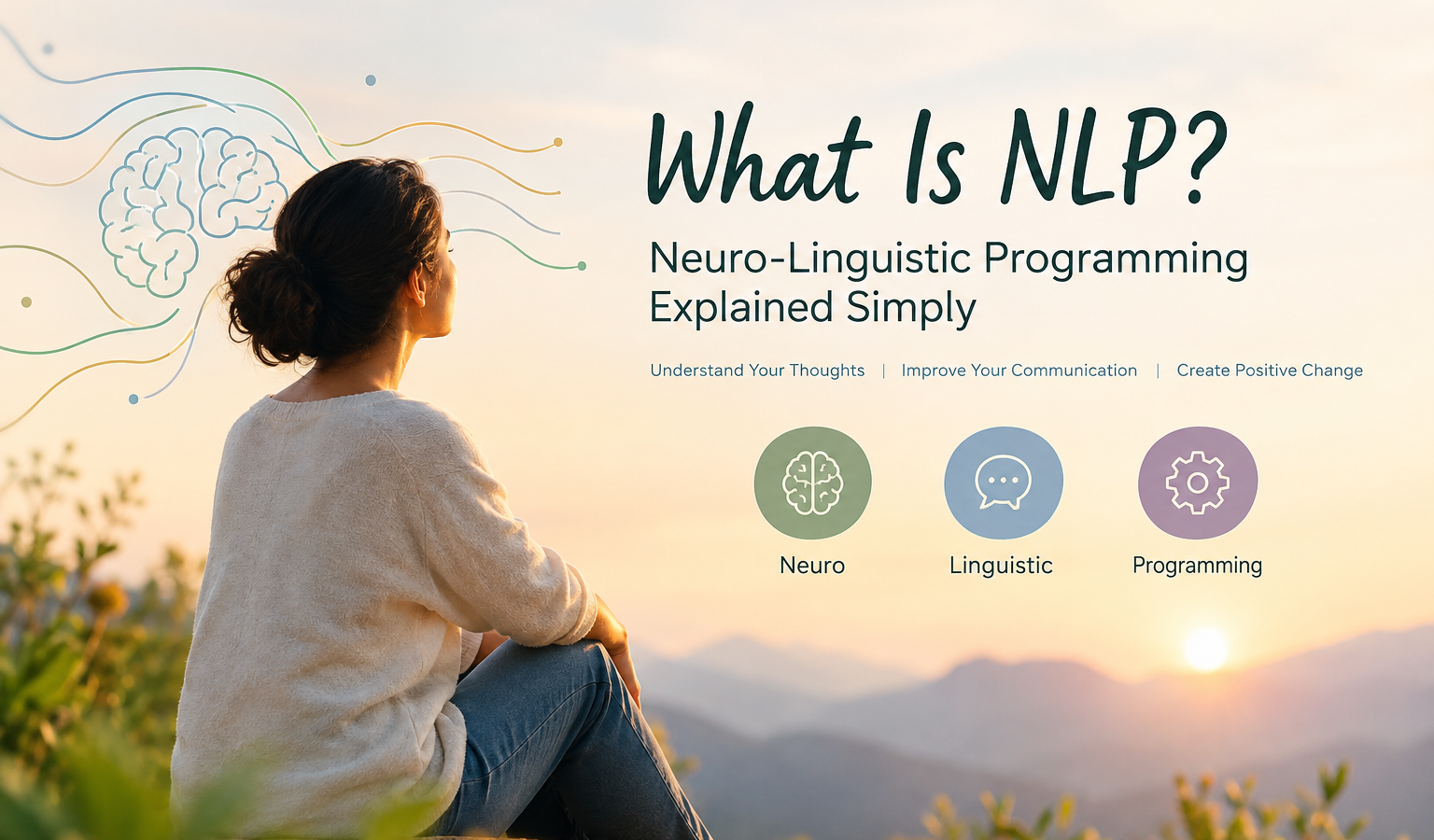
The three words describe three connected areas:
- Neuro – how we experience and process information
- Linguistic – how language influences the way we communicate and make meaning
- Programming – the patterns, habits and learned responses we develop over time
The term “programming” does not mean that human beings are machines. Rather, it refers to the patterns we learn and repeat, sometimes consciously and sometimes automatically.
Neuro: How You Experience the World
“Neuro” relates to the way we experience life through our mind, body and nervous system.
Think about a stressful situation. One person might immediately think, “I can’t handle this,” while another might think, “This is difficult, but I’ll figure it out.”
The external situation may be similar, but the internal experience can be completely different.
NLP is interested in understanding these internal patterns—what we notice, what we focus on, what meaning we give to an experience and how that influences our response.
Linguistic: The Language You Use Matters
“Linguistic” refers to language.
This includes not only the words you use when speaking to other people but also the language you use internally.
For example, compare:
“I always fail at this.”
with:
“I haven’t learned how to do this yet.”
The situation has not changed, but the language has.
The second statement creates more room for learning and action. NLP pays attention to language because the words we use can reveal patterns in the way we think and interpret our experiences.
Programming: The Patterns You Repeat
“Programming” refers to learned patterns of thinking, feeling and behaving.
Consider something as simple as checking your phone whenever you feel bored. After repeating the behaviour enough times, it can become almost automatic.
Similar patterns can develop around confidence, communication, decision-making, motivation and responding to pressure.
NLP encourages people to notice these patterns and ask an important question:
“Is this pattern helping me in this situation?”
If it is not, you can begin exploring another response.
How Does NLP Work?
A simple way to understand NLP is to look at the connection between:
Thoughts → Language → Feelings → Behaviour → Results
Imagine someone has an important presentation at work.
They think:
“I’m going to mess this up.”
That thought may influence their internal dialogue. Their body may become tense, their confidence may drop and they may avoid speaking with certainty.
Now imagine changing the internal conversation:
“I don’t need to be perfect. I just need to communicate my ideas clearly.”
The situation is the same, but the person’s relationship with the situation has changed.
NLP explores these kinds of patterns and provides practical models and techniques for developing greater awareness, flexibility and choice.
Common NLP Techniques
NLP includes a range of techniques and models. The usefulness of a particular technique depends on the person, situation and context.
Some commonly discussed NLP techniques include:
1. Reframing
Reframing means looking at an experience from a different perspective.
For example:
“I failed my interview.”
can become:
“I learned what I need to improve before my next interview.”
The event has not changed. The meaning attached to it has.
A different perspective can sometimes create different emotional and behavioural possibilities.
2. Anchoring
Anchoring involves associating a particular internal state with a specific cue.
For example, someone might develop a routine that helps them access a calm or confident state before an important presentation.
The goal is to become more intentional about accessing a useful state when needed.
3. Rapport
Rapport is about creating a comfortable and effective connection with another person.
Good rapport is not about manipulating someone. It is about listening, paying attention and communicating in a way that supports understanding.
This can be particularly useful in coaching, leadership, sales, teaching and everyday relationships.
4. Modelling
One of the interesting ideas in NLP is modelling.
Instead of simply asking, “Why is this person successful?”, modelling asks:
“What exactly are they doing that contributes to their success?”
This could involve looking at how they think, communicate, make decisions and respond to challenges.
NLP historically developed partly through studying effective communicators and therapists and identifying patterns that could be learned and applied elsewhere.
5. Language Patterns
The way we phrase questions and statements can influence conversations.
For example, instead of asking:
“Why can’t I do this?”
you might ask:
“What would help me do this better?”
The second question directs attention toward possibilities and action.
What Are the Benefits of NLP?
People explore NLP for different reasons, so there is no single outcome that applies to everyone.
NLP may be used to support areas such as:
- Self-awareness
- Communication skills
- Confidence
- Goal setting
- Motivation
- Personal development
- Leadership
- Learning and performance
- Relationships
- Managing unhelpful patterns
- Workplace communication
ANLP also describes applications across coaching, education, leadership, business, professional development, wellbeing and organizational settings.
The important point is that NLP should not be viewed as a magic solution. It is better understood as a set of approaches for exploring patterns and developing different choices.
Real-Life Examples of NLP
You do not have to be in a therapy room or a coaching session to notice NLP-related patterns.
Example 1: Fear of Public Speaking
Someone may think:
“Everyone is going to judge me.”
That thought can increase anxiety and make speaking more difficult.
Through awareness and techniques such as reframing, the person may begin to approach the situation differently:
“My job is not to impress everyone. My job is to share something useful.”
That small change in perspective can influence how the person feels and behaves.
Example 2: Workplace Communication
Imagine a manager who gives feedback by saying:
“You never do this correctly.”
This type of language can easily make the employee defensive.
A more constructive approach might be:
“Let’s look at what happened and see what we can improve next time.”
The objective remains the same, but the communication creates a different environment for the conversation.
Example 3: Building a New Habit
Suppose you repeatedly tell yourself:
“I’m just not disciplined.”
Instead, you could explore:
“What makes it easier for me to follow through, and what usually gets in the way?”
This shifts the focus from labelling yourself to examining the pattern.
That shift can create more opportunities for change.
Where Is NLP Used?
NLP is used in a variety of personal and professional contexts, including:
Personal Development
People may explore NLP to understand their thinking patterns, improve self-awareness, build confidence or work toward personal goals.
Coaching
NLP techniques and models are sometimes incorporated into coaching conversations to help clients explore goals, perspectives, communication and behavioural patterns.
Leadership
Leaders can use NLP-based communication approaches to improve listening, feedback, relationships and team communication.
Education
NLP may be explored in relation to learning, communication, motivation and performance.
Business
Communication is central to almost every business. NLP approaches may be used in areas such as negotiation, sales, customer communication, management and team development.
Relationships
Understanding how people communicate and interpret situations can help create more thoughtful conversations and reduce unnecessary misunderstandings.
Is NLP the Same as NLP Therapy?
Not exactly.
NLP is a broader approach involving thinking, language, communication and behaviour. It is used in different contexts, including personal development, coaching, education and business.
Some practitioners may use NLP within therapeutic or wellbeing contexts, but NLP should not automatically be treated as a replacement for medical or mental-health care.
If someone is experiencing a medical or psychological condition, they should seek appropriate support from a qualified healthcare or mental-health professional.
Does NLP Really Work?
This is one of the most important questions to ask.
NLP has been popular since its development in the 1970s and has been used in areas such as personal development, communication and performance. However, the scientific evidence supporting NLP is mixed, and some claims associated with NLP are stronger than the available evidence supports. Medical News Today also highlights the need to consider the evidence behind NLP rather than simply accepting every claim made about it.
That does not mean every NLP exercise is automatically useless. It means it is important to distinguish between practical communication or coaching techniques and claims that present NLP as a guaranteed treatment or scientifically proven solution for every problem.
A responsible practitioner should be clear about what NLP can and cannot do.
Common Myths About NLP
Myth 1: NLP Is Mind Control
NLP is sometimes portrayed online as a way to control other people’s minds.
That is not an accurate way to understand responsible NLP practice.
Communication skills can influence conversations, but influence is not the same as controlling another person’s thoughts or decisions.
Myth 2: NLP Can Fix Everything Instantly
There is no universal technique that can instantly solve every personal or emotional challenge.
Meaningful change often requires awareness, practice and time.
Myth 3: NLP Means Manipulation
Any communication method can be used ethically or unethically.
Professional NLP practice should respect personal boundaries, informed choice and individual autonomy.
Myth 4: Everyone Experiences NLP in the Same Way
People have different histories, beliefs, personalities and ways of responding.
A technique that feels useful to one person may not have the same effect on another.
Who Can Benefit From Learning NLP?
NLP may be worth exploring if you are interested in understanding yourself and communicating with others more effectively.
It may be particularly interesting for:
- Coaches
- Trainers
- Teachers
- Managers
- Entrepreneurs
- Sales professionals
- HR professionals
- Leaders
- Therapists and wellbeing professionals working within their appropriate scope
- People interested in personal development
You do not need to be a professional to find value in learning about communication and behavioural patterns.
NLP in Everyday Life
One of the simplest ways to start exploring NLP is to become curious about your own patterns.
The next time you feel stuck, pause and ask yourself:
What am I saying to myself right now?
Then ask:
Is there another way I could look at this situation?
And finally:
What response would be more useful to me right now?
These questions may sound simple, but they can create a useful pause between an automatic reaction and a conscious response.
That pause is where greater choice can begin.
Final Thoughts: What Is NLP Really About?
So, what is NLP?
At its simplest, Neuro-Linguistic Programming is an approach to exploring the relationship between how we think, how we use language and how we behave.
It encourages us to notice patterns that may otherwise operate automatically and consider whether those patterns are helping us achieve the results we want.
NLP is not magic, mind control or a guaranteed quick fix. Its most useful application is often much simpler: becoming more aware of how we communicate, think and respond—and becoming more flexible in the choices we make.
If you are curious about NLP, start with observation.
- Notice your language.
- Notice your assumptions.
- Notice your reactions.
- And ask yourself:
“Is there another way of looking at this?”
Sometimes, meaningful change begins with nothing more than a better question.
FAQs About NLP
What is NLP in simple words?
NLP, or Neuro-Linguistic Programming, is an approach that explores the connection between thoughts, language, behaviour and learned patterns. It can be used to develop greater awareness and explore different ways of communicating and responding.
What does NLP stand for?
NLP stands for Neuro-Linguistic Programming.
What is NLP used for?
NLP is used in areas such as personal development, coaching, communication, leadership, education, business and performance.
Is NLP a form of psychology?
NLP draws on ideas related to communication, behaviour and subjective experience, but it should not simply be treated as synonymous with mainstream psychology. Different claims about NLP have different levels of evidence.
Can NLP change your mindset?
NLP techniques may encourage people to examine their thoughts, language and behavioural patterns and consider alternative perspectives. The outcome depends on the individual and how the approach is used.
Is NLP scientifically proven?
Evidence for NLP is mixed, and not all claims made about NLP are well supported by scientific research. It is therefore important to approach strong therapeutic or medical claims critically and use appropriate professional care when needed.
Is NLP useful for personal development?
NLP may be useful for people interested in self-awareness, communication, confidence, goal-setting and behavioural patterns. Its usefulness will vary from person to person.
Is NLP manipulation?
NLP itself should not be equated with manipulation. Ethical practice focuses on communication, awareness and personal choice rather than controlling another person’s thoughts or behaviour.
In short: NLP starts with curiosity—about how we think, how we communicate, and how those patterns shape what we do next.